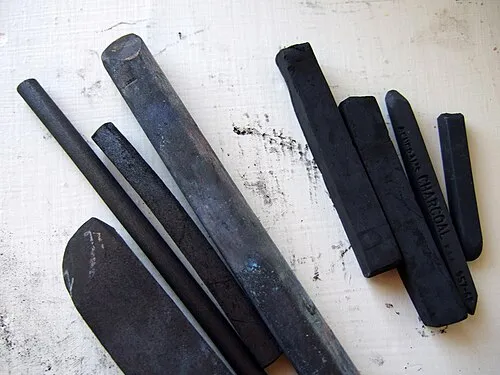
Technique: Charcoal
With this article, as with the rest of my “Technique” articles, I just want to suggest what can be done with the material. Use this page as a jumpstart for your own experiments with charcoal. Find the way of working that suits you best!
Side of the Stick
Instead of using the charcoal like a pencil, lay the charcoal horizontally on the paper. This allows you to lay soft, even, tones in large areas.
Blending
Since charcoal has no binding material, the particles will lift easily in response to any touch. Moving the particles around after you’ve laid them down on the paper is where most of the fun and interaction is.
- Use your fingers.
- Use a tortillion/blending stump.
- Use a chamois or cloth.
- Use a brush.
- Use a q-tip.
Wipeout
As an extension of the previous idea, try laying down large areas of darkness, and then use your tools to recover the lightness.
- Use your fingers.
- Use an eraser.
- Use a brush.
Charcoal Wash
Fine charcoal particles will disperse easily in water. You can use it like ink. If you are working on a thick paper that can withstand getting wet, try going over your charcoal with a wet brush.
Water Textures
Use a spray bottle to apply textural effects to your drawing.
You can also try adding water to the paper and tilting it to get drip effects.
Charcoal Dust
Grind the charcoal stick into a fine powder. Use a cotton ball or a brush and dip it in the powder. Apply to paper.
Layered Papers
For a softer response to pressure, place your paper on top of a stack of other papers.
Paint Compatibility
Use as an underdrawing for oil and acrylic.
Or, going over the top of an already dry watercolor.