
This article covers basic concepts and vocabulary regarding color that I expect all students to know.
A precise definition can be quite difficult. So, for our purposes the following definition will suffice, the hue of a color refers to the color that it most resembles on the rainbow. (Though a sharp student may realize that the color magenta never appears on the rainbow... For a more in-depth treatment, read my article on color and light. )

Saturation refers to how vivid or "pure" a color is. A total lack of saturation in a color would give us gray.

Value refers to how dark or light a color is.
This is just a shorthand way of saying if a color is more blue-ish (cool) or orange-ish (warm).
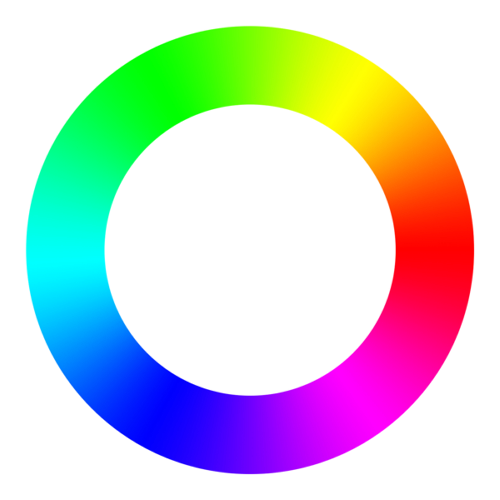
A color wheel is circular map used to organize hues. It’s the primary tool artists use to pick color schemes and predict what will happen when they mix two colors together. The color wheel that includes magenta is shown above. However, for many artists, they find that using the traditional RYB color wheel (which has no magenta) results in more agreeable color schemes. See below.
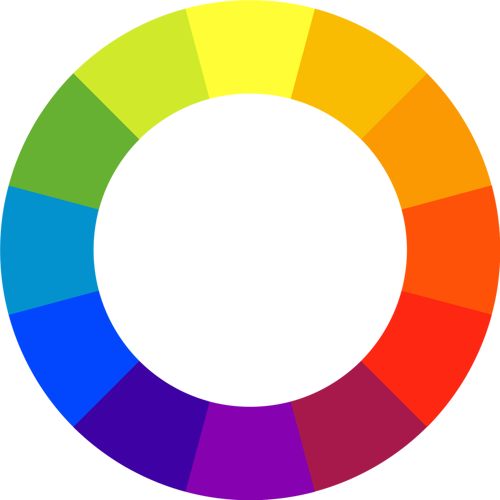
Two colors are said to be complementary if they are on opposite sides of the color wheel. For example, red and green are typically said to be complementary, and on the RYB color wheel, they are.
A collection of colors are said to be analagous if they are near each other on the color wheel.
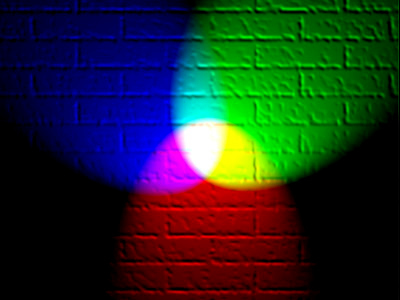
Red paint plus green paint does not give us the same color as if we mixed a red light with a green light. The former would give us a black or dark gray. The latter will give us a brilliant yellow. Colors mix differently depending on if you are mixing paints or if you are mixing lights together. Mixing paints together is an example of what we call subtractive color mixing. Mixing lights together is an example of what we call additive color mixing. For more on this point, read my other article on color and light.
Primary colors are the colors from which you can mix all the other colors. Of course, in conversation, you should make it clear with your listener what model of color you have in mind. Secondary colors are halfway between on the color wheel from your primary colors. Tertiary colors are the colors in between the primaries and secondaries.
The primary colors for subtractive color mixing are cyan, magenta, and yellow. Printer inks come in packages of cyan, magenta, and yellow. The primary colors for additive color mixing are red, green, and blue. If you look close enough into the display of your smartphone, desktop computer, or television, almost certainly, you should be able to see that the display is comprised of millions of tiny little red, green, and blue lights.
For traditional painting, many artists and educators still insist on using red, yellow, and blue as their primary setup. This is fine. Planning color schemes along this arrangement tends to give more harmonious results.